

CURRENT ACCREDITATIONS

The Blood-Brain Barrier Challenges in Brain Penetration
Delivering therapeutics to the brain to treat Parkinson's Disease (PD) is severely limited by a complex series of physiological and biochemical hurdles. While systemic drug levels may be adequate, the true brain bioavailability—the fraction of the drug that successfully crosses into the brain parenchyma to reach dopaminergic neurons—remains critically low.
Extensive First-Pass Metabolism: Oral therapies are aggressively metabolized in the gastrointestinal tract and liver. For instance, without peripheral inhibitors like carbidopa, the gold-standard drug Levodopa (L-DOPA) is rapidly converted to dopamine in the periphery, leaving less than 1% to reach the brain.
Transporter Competition: L-DOPA relies on the Large Neutral Amino Acid Transporter 1 (LAT1) to cross the BBB. This creates a highly saturable process where dietary proteins and amino acids directly compete with the drug, leading to unpredictable brain concentrations and the clinical "on-off" motor phenomena.
.Gastrointestinal Dysmotility: PD patients frequently suffer from gastroparesis, erratic gastric emptying, and gut dysbiosis. This slows down and disrupts the absorption window of oral medications well before they reach systemic blood circulation.
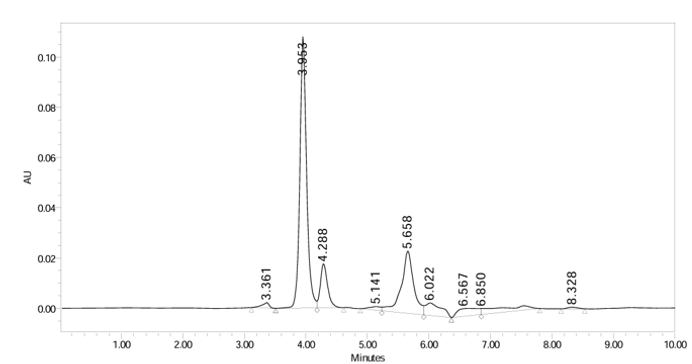
Chromatogram
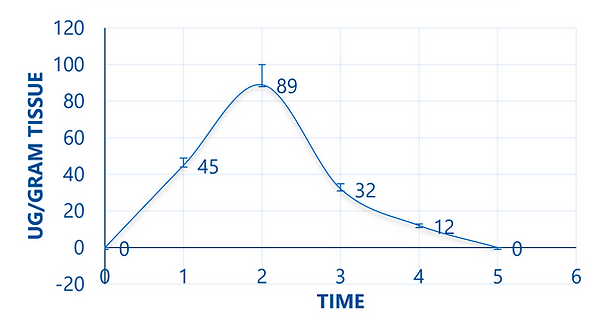
Biodistribution in Brain
Solution
Serial time-point sampling was performed on the same animal subjects to evaluate the following parameters:
In Vivo Pharmacokinetics
(Brain/Plasma Ratio): Measures total drug concentration in brain tissue relative to plasma.
Unbound Concentration: Determines the active therapeutic species by calculating the ratio of unbound drug in the brain to unbound drug in plasma.
Brain Microdialysis: Tracks real-time, free (unbound) drug concentration within the brain's extracellular fluid.Key Outcome
This methodology successfully optimized compounds to enhance brain penetration by up to 83%, significantly improving central nervous system (CNS) bioavailability.
Our Services
1
Dosing Route
-
Oral Solid Pellets / Coated Pellets / liquids / Emulsions
-
Intramuscular
-
Subcutaneous
-
Intraperitoneal
-
Intravitreal
-
Intrathecal injection
-
intracranial
-
Intranasal
-
Intra-articular
-
Water Dissolution
2
Analyte Sources
-
Blood - Repeat measure from the same animal through dorsal aorta draw
-
CSF
-
Organs
-
Regions of organs lobes, ventricles, Cortex, Chambers
-
Regenerative Tissue
-
Thymus, Spleen and Kidney
-
Swim Water
3
PK Assessments
-
Area Under the Curve
-
Drug concentration vs time plot
-
Time to peak drug concentration
-
Peak serum concentration
-
Biological half-life
-
Volume Distribution
-
Steady state volume of distribution,
-
Clearance